


Proper cleaning of porcelain tiles is essential to preserve its original appearance, but it is easy to give in to the temptation to use home remedies. However, solutions such as vinegar or ammonia are ineffective and potentially harmful. These products often contain aggressive or acidic ingredients that can cause corrosion and damage the floor surface over time, leaving it opaque and compromised. In addition, home remedies are not formulated specifically for cleaning porcelain tiles and may not be able to remove stubborn stains, stains or laying residues effectively.
To achieve safe and extraordinary results, it is essential to rely on specially formulated products, such as POWER DET, able to clean any type of porcelain tiles, from opaque to shiny.
Effective cleaning of porcelain tiles with Power Det
POWER DET is a concentrated detergent designed for the extraordinary stain removing cleaning (as well as after-installation) of all porcelain tiles surfaces.
It is a product that has among its characteristics those of degreasing, descaling and removing patinas and substances caused by limestone, detergents and grease and is ideal for cleaning porcelain tiles surfaces.

Thanks to its correct use it is possible to carry out an extraordinary cleaning, able to bring the surface back to its original appearance.
How to use Power Det correctly
For extraordinary cleaning, this product must be diluted in water (1 part detergent in 1 or 2 equal parts of water) on the affected porcelain tiles surface and then spread abundantly with the use of a cloth.
Working 4-5 meters at a time, it is then let to act for at least 10 minutes, without letting it dry on the surface.
At this point you have to rub the porcelain tiles with blue discs or buffers made of plastic fibers, then collecting the dirt and product residues with a microfiber cloth or with a liquid vacuum cleaner.
The operation ends by rinsing 2 or 3 times with clean water, until the removal of the product and dirt from the surface is complete. You can repeat, if necessary, the whole application.
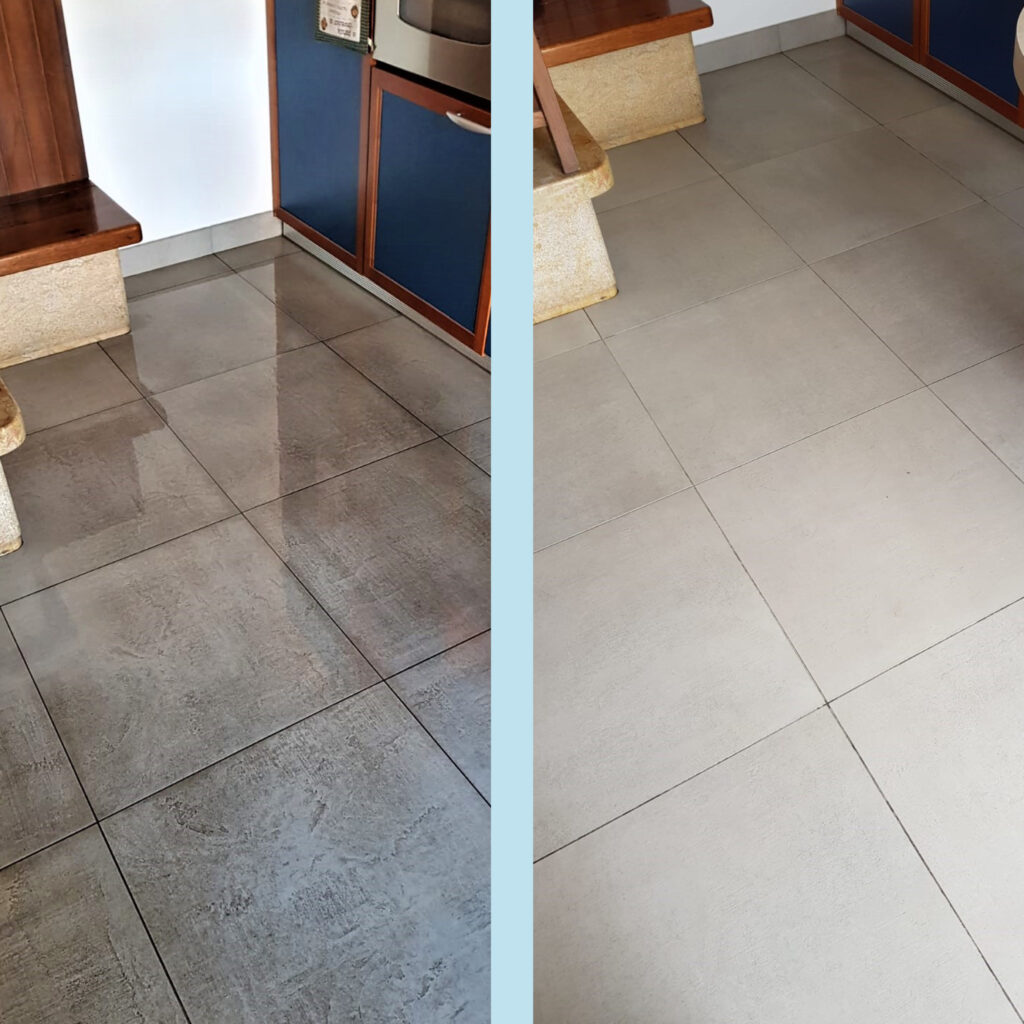
Thanks to POWER DET it is therefore possible to achieve an effective result, by removing in a decisive way the stains, stains and residues of the porcelain tiles.
However, in order to maintain the result obtained over time, it is recommended to use two ordinary cleaning products, such as GRES LINDO and GRES BRILL.
Stain prevention on porcelain tiles: two recommended products
GRES LINDO and GRES BRILL are two detergents for ordinary cleaning, perfect to prevent the appearance of stains on porcelain tiles.
The first is a concentrated detergent able to eliminate ordinary dirt over time and prevent contamination of patinas and fatty substances. GRES LINDO also dries quickly without rinsing, retains the original color of the surface and does not contain ammonia, caustic soda and potash.
GRES BRILL, also this ideal for ordinary and daily cleaning of porcelain tiles, has, exactly like GRES LINDO the quality to dry quickly and to ensure the maintenance of the original gloss and color of the surface.
It is to be used 1 or more times a month on opaque porcelain tiles and is an alternative to the product GRES LINDO.
In conclusion, POWER DET is the best solution for the extraordinary cleaning of porcelain tiles, able to guarantee satisfactory results, bringing this surface back to its original appearance.
-

POWER DET®
Specific detergent for porcelain tiles for extraordinary cleaning to remove halos, stains, and any laying residues. It brings the material back to its original appearance.
+ Varianti20.80€
-
GRES BRILL®
Concentrated descaling detergent for surfaces in porcelain tiles and ceramic materials. It cleans and removes dirt, halos, and limestone patinas due to domestic water.
+ Varianti8.39€
-
GRES LINDO®
Concentrated degreasing detergent for surfaces in porcelain tiles and ceramic materials. It cleans, degreases and does not contaminate the material with soaps and surfactants. It keeps the joints and the floor clean.
+ Varianti8.00€


Inside a residential complex in Lucca, in Italy, an outdoor travertine staircase showed clear signs of advanced deterioration. Over time, constant exposure to rain, humidity and weather conditions led to heavy contamination from algae, mould and biological buildup. As a result, the surface became dark, uneven and slippery. Consequently, both aesthetics and safety declined. In cases like this, simple cleaning does not solve the issue. Instead, professionals need a structured craft restoration process, carried out with care and precision. EcoTecnologia di Pulitura by Orsucci Paolo handled the intervention. The company specialises in the professional restoration of natural stone surfaces.

In the historic center of Pistoia, Italy, inside a charming period building, a handmade antique terracotta floor underwent a highly specialized restoration process. At first glance, the surface looked heavily compromised. An old treatment had deteriorated over time and made the terracotta dark, uneven, and difficult to read. Therefore, simple cleaning was not enough. Instead, the situation required a precise technical intervention carried out by professionals who truly understand the material. For this reason, the work was carried out by Pippolo Company by Timpano Giuseppe, a company specialized in the professional restoration of historic terracotta floors.


