


Do you have a matt or shiny porcelain floor tiles? Do we bet that every time that you clean it, it remains stained by halos, stripes, prints and so on? Don’t worry! You’re not alone. The not enamelled porcelain tiles, is one of the most difficult material to remove the stains and to keep it clean. Don’t be afraid: we have the solution! In this article we explain to you how to clean a matt or shiny porcelain floor tiles without fatigue. Before you know how to do it, let’s start from the beginning: why porcelain tiles are so difficult to clean?
Microporosity, the cause of the stains on the porcelain tiles
What commonly called porcelain tiles is a paste of clays and materials of different kinds. All the type of tiles in porcelain tiles, from the little ones, pink, 10×10, to the big ones, 50×50 enamelled and similar to terracotta, stones or to wooden floor are made of a paste of very little powders that is mixed and baked in a furnace at about 1200 degrees of temperature. At the end of this process we obtain a very resistant material against the abrasions, impermeable and with a very long duration: exactly the porcelain tiles. Thanks to these characteristics the porcelain tile is a perfect material to make tiles and other materials for coating. Whilst the production process creates a very resistant material, we have a disadvantage. The porcelain tile, in fact, is a microporous material. It means that its structure presents porous at a microscopic level. It’s exactly in these porous that the dirt lurks, so difficult to eliminate. So, to clean successfully the matt porcelain tile we have to consider that it’s a microporous material.
What substances create opaque porcelain stoneware stains?
Despite its resistance, porcelain tiles frequently has problems with stains and indelible stains.
To avoid these problems, even before understanding how to clean porcelain tiles, it is essential to know the harmful substances that coming into contact with the surface are likely to ruin it forever.
The cause of the appearance of stains on matte porcelain tiles may depend on:
- Floor installation residues that have never been adequately eliminated and that form a patina on the floor invisible to the naked eye, but that retains dirt.
- Use of detergents not suitable for cleaning porcelain tiles: many times in fact, it is precisely the products used to wash the floor that create the halos. Detergents rich in surfactants, chemical compounds that dissolve dirt and tend to grease the surface. Porcelain tiles floors do not need this kind of aggression, but something more suitable and delicate.
- Polishing products: the same “insidious” patina that captures dirt, can be created on porcelain tiles by polishing effect products that contain waxy substances.
Read on to find out how to remove stains from matte porcelain tiles.
How to clean the porcelain tile: the products that you don’t have to use
How many times do you fight against the dirt on your natural porcelain floor tiles? Prints, halos, stains: only a simple drop of water can cause a big trouble. You tried all: even the vapour. Not to mention all the detergents, perfumes and colours. But nothing, your porcelain floor tiles remains scarred by the dirt, even though the repeated washes. Is it true? We reveal to you a thing: the detergents that you use are the problem: The common detergents bought at the supermarket are what precludes to your porcelain tile to be cleaned Amazing, isn’t it? Until now you keep using the most advertised product, the most expensive, perfumed, certified but nothing changed: your matt porcelain floor tiles remains dirty and full of halos. The problem is that the supermarket detergent contains surfactants. These chemical compounds are the active substances of the majority of the detergents. Their task is to dissolve the dirt and make it washable. Moreover, they decrease the superficial tension of the water, making it “more wet”. Well, it’s exactly this that a detergent has to do, isn’t it? Yes: but it’s not true for the porcelain floor tiles. When you wash a floor made of this material, the surfactants contained in the supermarket detergents remain on the surface. In the moment when you drop the water on the floor, these surfactants, deposited previously dissolve themselves and they penetrate into the micropores. And here that the halo is formed and the floor looks stained.
So, this is an answer to the question “how to clean the porcelain tile”? To clean the porcelain tile, we need to use a detergent with a very low content of surfactants. A product like this exists, but you have to look for it very well. For this reason, we recommend one to you. Its name is GRES LINDO, a concentrated detergent studied for floors in microporous material. To dissolve the dirt, Gres Lindo. The inorganic salts like sodium or potassium clean the floor, but they don’t leave the coat of surfactants that creates halos.

Where there is a very strong calcareous water, it is also recommended the use of GRES BRILL anti-limescale concentrated detergent, which does not contain strong acids and is ideal for frequent washing.


Do you have stained porcelain floor? Surface protection is sometimes applied to porcelain tiles floors, which in some cases degrades with substances common in our homes (e.g. lemon, decalcarizing detergents, urine, vomiting, etc.) resulting so spotted and haloed especially if seen against the light. In these specific cases, the only solution is to make an intense cleaning with POWER DET in order to remove the protection and at the same time the halos and return the material to the raw. POWER DET, ideal for porcelain tiles cleaning, is a concentrated detergent for degreasing and descaling, specifically for removing stubborn residues from laying and stains from porcelain, klinker and glazed ceramics. The combination of solvent and acid functions allows it to attack both organic dirt (fats, oils, polymers) and inorganic dirt (limestone, oxides). This detergent is particularly suitable for cleaning hard ceramic surfaces from the residues of grout and polymeric bonding mortars, also coloured.
A stain resistant to have a porcelain stoneware matt always clean
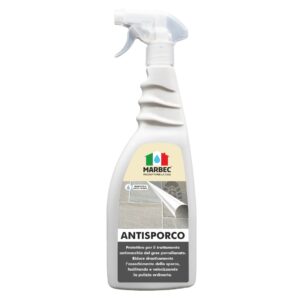
Well, we’ve eliminated the halos, but it’s not enough. Why don’t you dare and protect the porcelain floor tiles ensuring that it’ll never stain itself again? It seems a task suitable for a product against the dirt! The perfect product for this task is ANTISPORCO. It’s a protector made of water that don’t use solvents to take reaction: it’s perfect for houses with children. ANTISPORCO is studied for microporous materials like the porcelain tile. Spray ANTISPORCO on the surface, in small amounts, until it’ll be homogeneously distributed: it will ensure you from 3 to 6 months of cleaning on your floor. Clean the porcelain tile has never been so easy!
Do you want to have more information on how to protect your porcelain floor tiles?
Contact us! Our experts will give you all the information on the product and how to use it.
-

POWER DET®
Specific detergent for porcelain tiles for extraordinary cleaning to remove halos, stains, and any laying residues. It brings the material back to its original appearance.
+ Varianti20.40€
-
GRES LINDO®
Concentrated degreasing detergent for surfaces in porcelain tiles and ceramic materials. It cleans, degreases and does not contaminate the material with soaps and surfactants. It keeps the joints and the floor clean.
+ Varianti7.84€
-
GRES BRILL®
Concentrated descaling detergent for surfaces in porcelain tiles and ceramic materials. It cleans and removes dirt, halos, and limestone patinas due to domestic water.
+ Varianti8.22€
-
ANTISPORCO
Product for the stain-resistant treatment of porcelain tiles. It drastically reduces the absorption of dirt, facilitating and speeding up ordinary cleaning.
+ Varianti16.43€


Sodium percarbonate is a water-soluble powder widely used to remove stains, whiten laundry, and support hygienic cleaning on fabrics and washable household surfaces. When dissolved in water, it releases oxygen. This reaction helps break down stains and organic residues in a simple and effective way. If you often deal with yellowed white clothes, stains that remain even after washing, bins that keep unpleasant smells, shower curtains with marks, or surfaces dulled by residues and streaks, you are probably looking for exactly this kind of solution. However, sodium percarbonate is not designed for heavy degreasing. If you need to remove thick grease layers or stubborn encrustations, a dedicated degreasing detergent will work better.

Hand washing dishes is part of everyday home life. Whether you clean up after a quick lunch or a family dinner, the product you use makes a real difference. However, many people choose a dish detergent out of habit, without considering the practical differences between a concentrated dish soap and a traditional dishwashing liquid. A concentrated formula can offer clear advantages in terms of performance, yield, and dosing control. Therefore, it is useful to understand what truly changes between these two options and when a concentrated solution is the smarter choice for daily dishwashing.


