


Treatment of external cotto of the Abbey of S. Maria di Rosano
15 May 2023
This month, with the column dedicated to the most beautiful work of the month, we are in our Tuscany but, with an ideal time machine, we travel in the past to take you outside and inside the walls of the abbey of Santa Maria a Rosano.
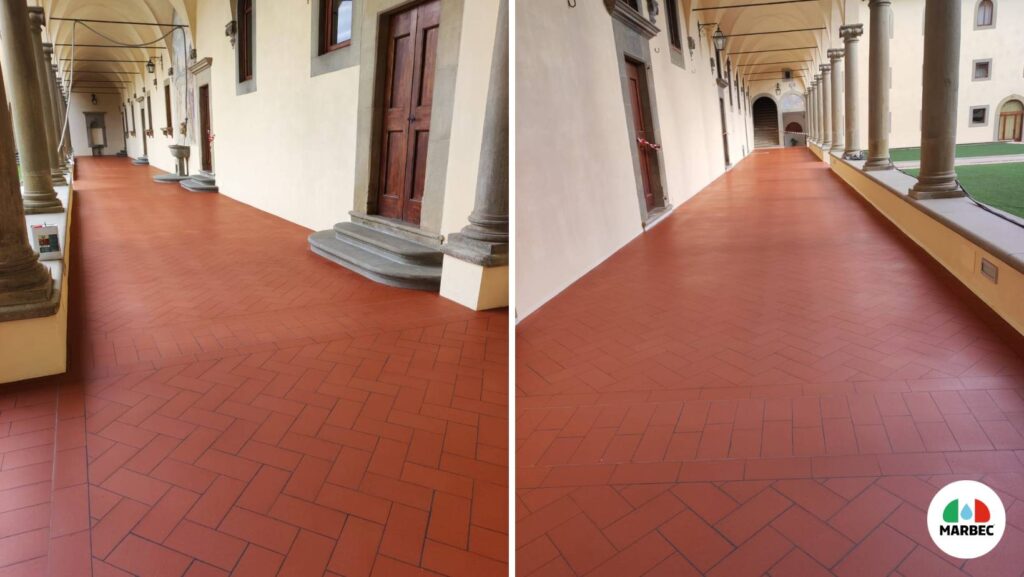
The occasion is the treatment of the external cotto of this monastery, made by the artisan company Lai Giovanni, specialized in the recovery, among others, of surfaces such as porcelain tiles, stone and indeed internal and external cotto floors.
Before, however, to see how the artisans of this enterprise have worked, we take a leap into the past to rediscover the history of this historic structure.
The monastery of Santa Maria a Rosano
Located in the municipality of Rignano sull’Arno, in the province of Florence, the monastery of Santa Maria a Rosano is a female abbey of the Order of Saint Benedict and has received, over time, several visits from Cardinal Ratzinger before he became Pope.
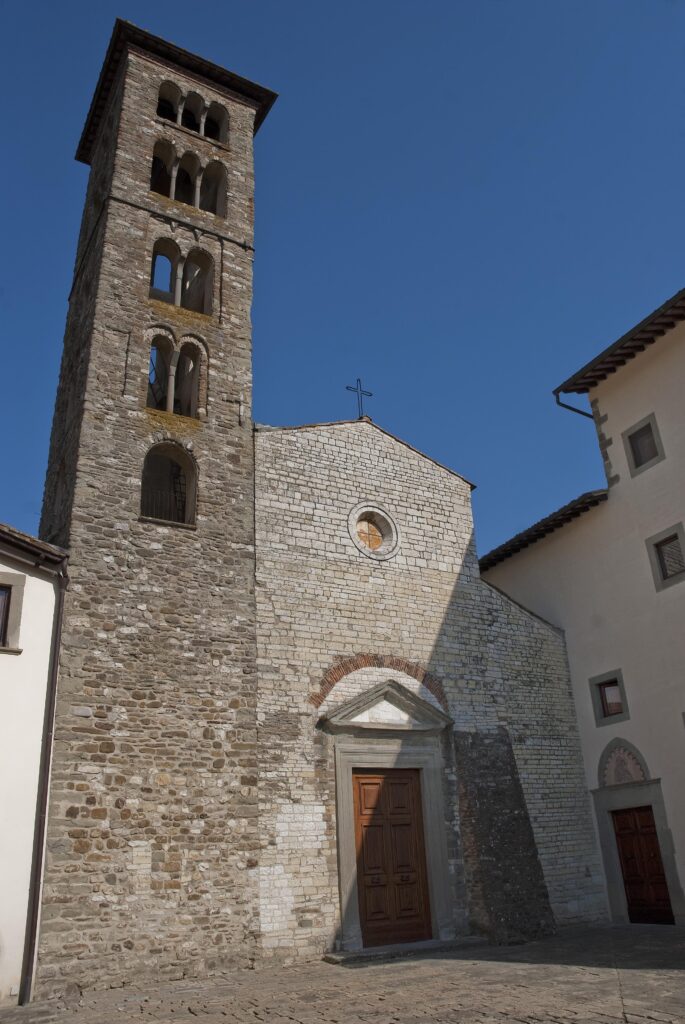
This abbey, founded in 780, became in 1040 an allodial property of the Guidi Counts, but they lost the patronage in 1204, after the structure was destroyed in 1143 by the Florentines, just in the battle against the house that owned it.
Particularity of this abbey is the presence of the crypt, which distinguishes it from similar structures found in the Upper Valdarno and Casentino. Modernized in 1696, after the renovation occurred in 1502, it preserves the “Cross painted with stories of the Passion” of the Master of Rosano, in whose cavities relics similar to those that the crusaders brought back from the Holy Land have been found.
Other works, finally, that are inside this abbey are an “Annunciation” by Jacopo di Cione, dating back to around 1365, and the Annunciation with Saints Lorenzo, Benedetto, Giovan Battista and Nicola” by Giovanni da Ponte of 1434.
The treatment of external cotto
The Tuscan cotto was laid with glue in the floor of the external cloister of the Benedictine Abbey of Santa Maria a Rosano and then stuccoed and polished.
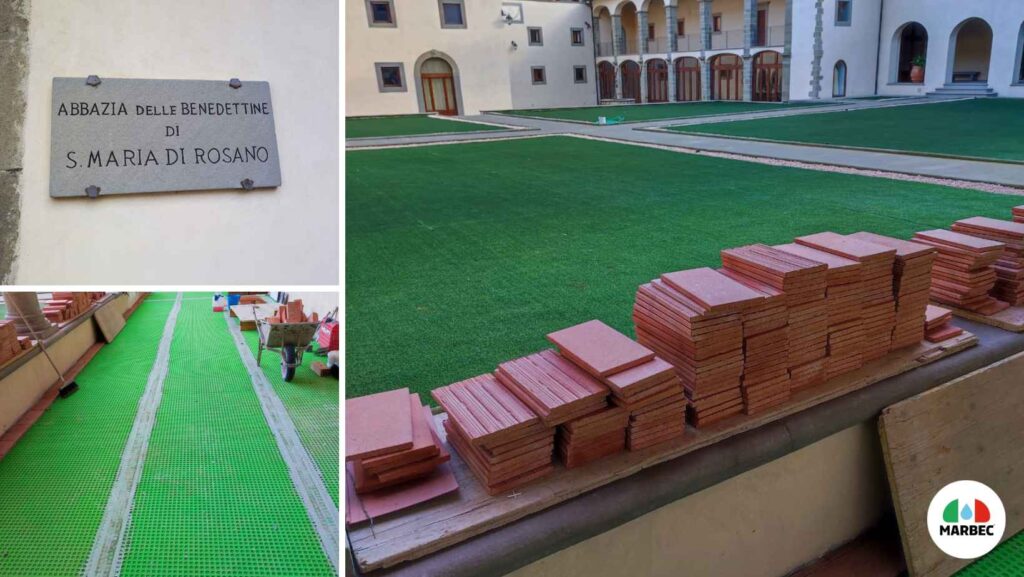
For its treatment, the team of artisans of the company Lai Giovanni, after drying, washed the cotto with a diluted solution of DELICACID, the buffered acid detergent specific for this type of surface, and with a single brush equipped with BROWN DISC.
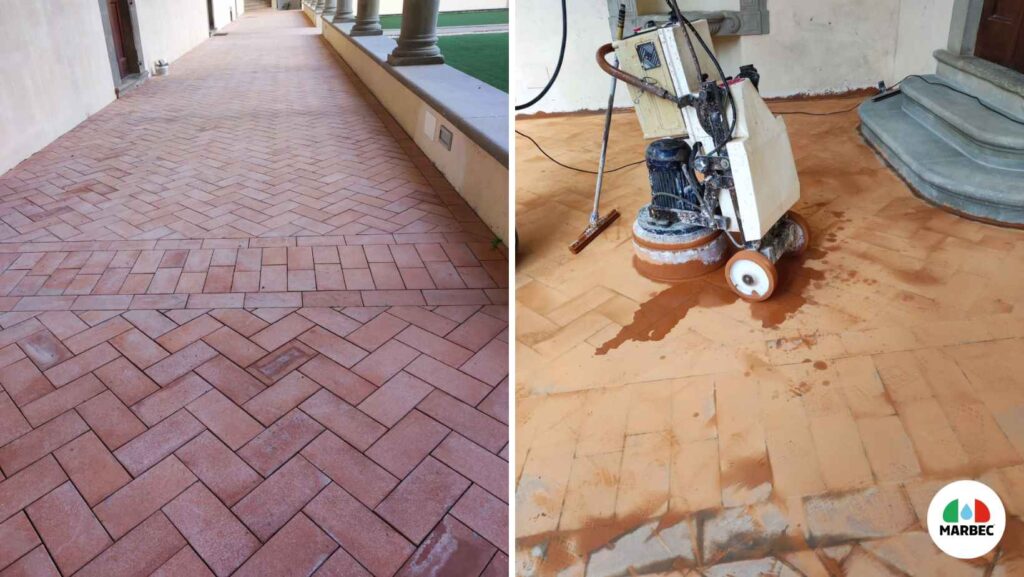
At this point the team of the talented craftsmen of Lai Giovanni waited for the cotto to be perfectly dry to apply two coats of the WET OUT oil-waxy impregnation, which protects and highlights the characteristics of the material, avoiding creating superficial films.
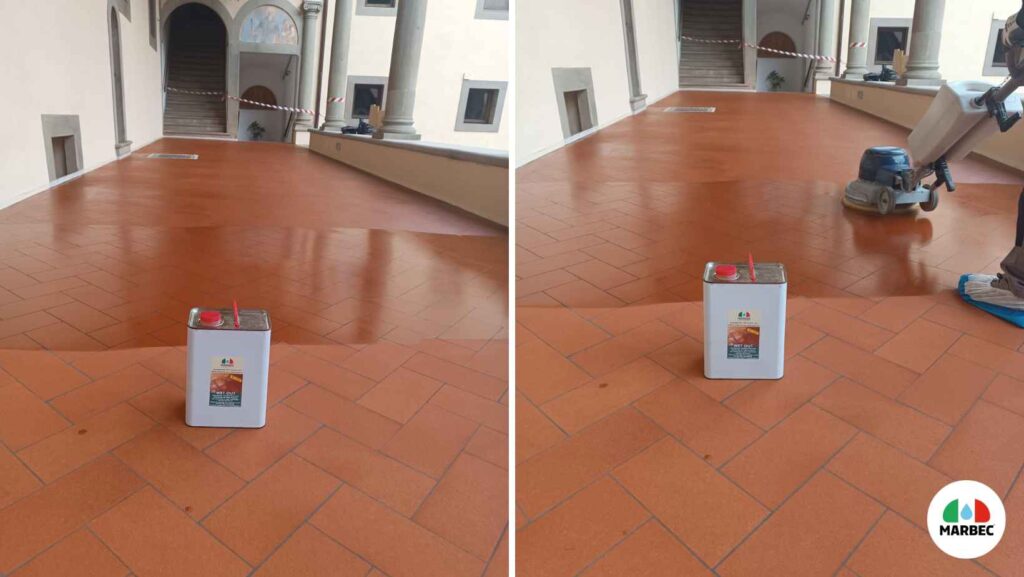
Thanks to the extraordinary work of this artisan enterprise, which operates throughout Tuscany, the cotto of this abbey that smells of history has thus managed to recover its splendor.
-

DELICACID®
Specific buffered acid detergent to remove cement grouts, efflorescence and limestone incrustations on stones, ceramic materials and stone materials in general.
+ Varianti8.32€
-

BROWN DISC MARBEC | Very Abrasive
The BROWN DISC is composed of a polyester structure with a high density of resin and mineral. It has high resistance to acid or alkaline substances, it is used wet to carry out manual dewaxing and descaling washes. Ideal for: Descaling cleaning on cotto and porcelain tiles; Dewaxing cleaning on cotto, stone and cement.
+ Varianti14.68€


Cleaning and restoring indoor varnished wood floors makes it possible to revive matte or glossy varnished parquet flooring that has lost its shine, even colour and original appearance due to everyday wear. When the protective finish is still intact and the floor does not require complete sanding, you can restore parquet without sanding by following a dedicated treatment that removes surface greying, revives the wood and restores the protective finish. This restoration process is suitable for both glossy and matte varnished parquet floors by selecting the treatment that matches the original finish. For this reason, Marbec developed the KIT RESTAURA LEGNO VERNICIATO LUCIDO and the KIT RESTAURA LEGNO VERNICIATO OPACO, two complete systems designed to clean, restore and protect varnished wood floors without sanding or refinishing whenever the floor is still suitable for surface restoration.

An oak parquet floor with an oil-wax impregnation can lose colour, protection, and visual uniformity over time. This often happens because of incorrect maintenance or unsuitable products. However, if the wood is still structurally sound, replacement is not always necessary. With a professional restoration process, the surface can regain balance, beauty, and long-term protection.


