


Remove oil stains: how to remove them without leaving a trace
16 December 2022
Among the consequences of the lunches and dinners that await us during the Christmas holidays there is not only the one related to a certain heaviness of the stomach, but also the stains of oil and vegetable and animal fats that we, or our diners, can leave on the surfaces around the laid tables.
For this reason, it is useful, as never in this period, to have the right tools to remove oil stains that can form, and to do so, even in this case, you need to rely on the right specific products.
So let’s see how to make the recovery of stained surfaces with oil and animal/ vegetable fat during lunches and dinners of the Christmas holidays.
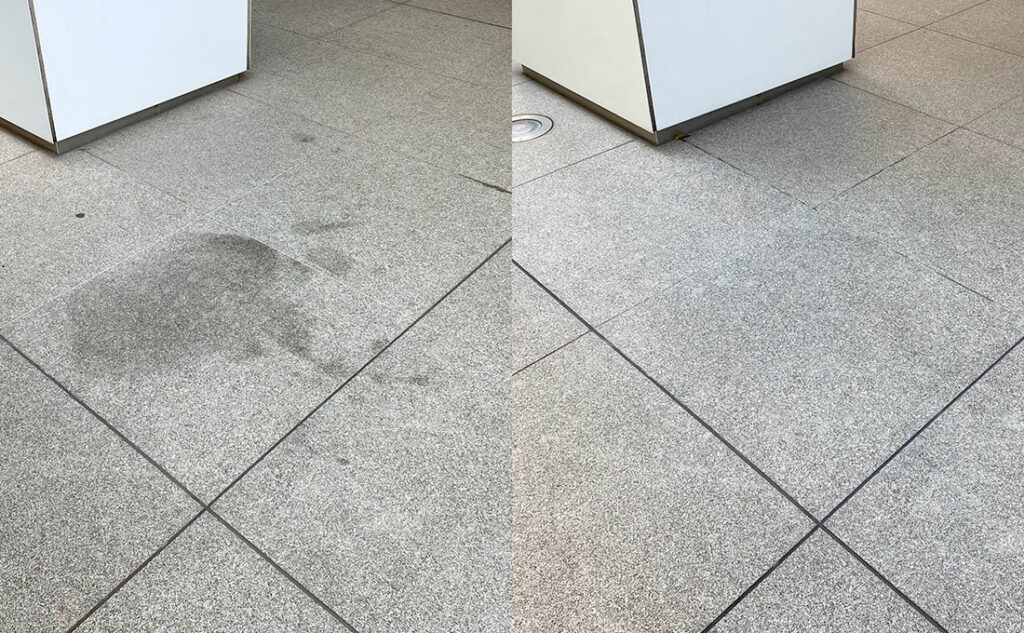
How to remove oil stains from stone materials
A first detergent that we can use for this operation if we are dealing with stone materials in cement, cotto, grit, marble, and stone, is definitely the strong de-waxing SGRISER.
It is an alkaline detergent that removes old oil and/or wax impregnation treatments, but is also ideal for strong degreasing cleaning, contributing to the removal of accumulations of greasy dirt as well as blackening in the exterior.
This cleaner, which does not leave harmful residues or unpleasant odors, can be used pure or diluted in an equal part of water (if a strong degreasing action is required) and must be laid on the surface, allowing it to act for a variable time between ten and twenty minutes.
Next, the surface should be rubbed with pads, discs, or nylon brushes, repeating the wash if necessary.
Remove oil stains from raw wood
A second product branded Marbec designed to remove oil stains (but in this case also candle wax, glues, silicones, and paints) is SOLVOSILL, a strong solvent remover thickened with powerful and deep action.
To use it you must first mix the product well, forming a fluid paste that must be applied with a spatula on the stained surface and then covering the stained part with food film to increase the duration of the extractive action.
You must then wait at least 12 hours (up to 24) for the impact to be dry and you can then proceed to dry removal with the use of a nylon brush or sorghum, finally rinse with an acid solution of DELICACID or UNIPUL, in the case of delicate materials such as grit and marble.
Note, in conclusion, that on some types of materials such as stones and compact materials the result will be visible after several days and the advice is to apply the product on all the areas affected by the stain and not only on the specific point, so as to avoid the formation of halos and ensure a uniform result.
Thanks to these products and following the advice of use it will be possible to remove oil and grease stains that, accidentally, could form on the surfaces of the house between a flow, to serenely live Christmas lunches and dinners with family and friends!
-

DELICACID®
Specific buffered acid detergent to remove cement grouts, efflorescence and limestone incrustations on stones, ceramic materials and stone materials in general.
+ Varianti8.32€


Scratches, stains and marble dulling are the order of the day. Let's find out the best technique to eliminate these annoying halos. Marble crystallization, traditional polishing, sanding, which one to choose?


