


Best job of the month: cleaning of the external courtyard in cement agglomerate of cobblestone and natural stones
30 September 2021
We move to Emilia to tell you about the work of the artisan Santi Ivano who has given new life to a courtyard made of cobblestone and natural stones.
Once again this section of our blog is an opportunity to travel along our peninsula.
This time we take you to Emilia Romagna, in particular to the town of Zocca (province of Modena), to virtually open the doors to Santi Ivano‘s company.
It is an artisan company rooted in the territory that operates throughout Emilia Romagna, specializes in the recovery of surfaces and, porcelain tiles, granite, cotto, stone, grit, terrazzo and cement agglomerates are the areas on which this company works.
Our attention shifts to the very last of the listed surfaces on which this company made in Emilia Romagna operates, namely the cement agglomerate. Going into even more detail we are talking about a cement agglomerate made up of cobblestone and natural stones that needed a good cleaning.
But before seeing how the artisan Santi Ivano worked, let’s get to know together the material on which this extraordinary intervention was made.
What is meant by agglomerate?
The agglomerate naturally falls within the construction field and is composed of stone material that is crushed through a mechanical action and then mixed with a binding substance and finally made compact and shaped.
Compared to other materials, such as granite and marble, it has qualities that make it very popular; in fact it has better aesthetic and mechanical characteristics, it is easier to find and also has lower costs.
As mentioned, the production process that leads to the construction of the agglomerate starts from a fragmentation operation (specifically of stone material) which leads to the formation of granules of various sizes.
These granulates are then inserted into special mixing machines and are subsequently mixed with cementitious mixtures or polymeric resins to then receive a “coloring” treatment through specific substances such as metal oxides.
At this point, to avoid the formation of bubbles, the air is extracted from the mixture and then the mixture obtained is introduced into a vacuum chamber. Here it is vibrated and compressed, obtaining its final size in this last phase.
Among the various types of cement agglomerates there are those composed of cobblestone and natural stones, on which it is important (as indeed on all surfaces, to obtain an excellent result and not compromise their aesthetic qualities) to operate with the right products and machinery, relying on qualified professionals.
So let’s see how the artisan Santi Ivano worked for the cleaning of an external courtyard in cement agglomerate of cobblestone and natural stones.
The cleaning of an external courtyard in cement agglomerate of cobblestone and natural stones
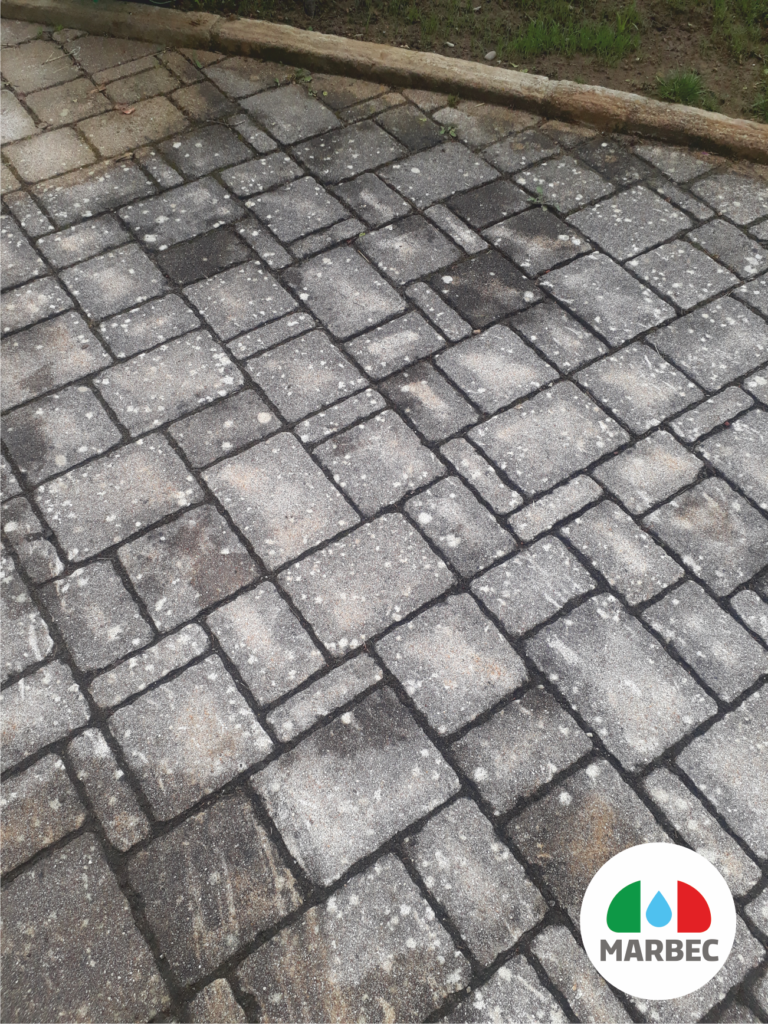
First of all, the artisan Santi Ivano applied ALGANET. A product that, as the name suggests, is an excellent ally for the removal of algae, as well as mosses, consistent residues and encrustations of various kinds.
Among its features there is certainly that of having a strong sanitizing power on the surfaces that need to be treated and it works more effectively than the classic bleach.
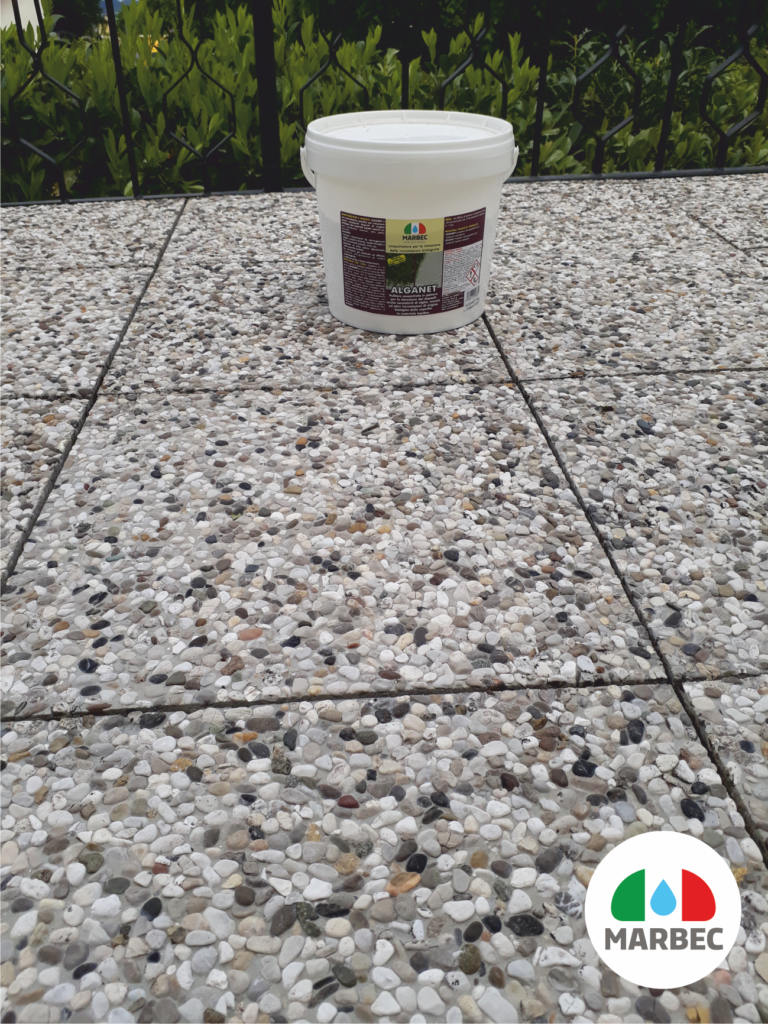
The craftsman left the product on for 48 hours, sufficient to dry the algae and the biological encrustations present, and then followed this first operation with the high pressure washer machines that allowed the removal of the now dry encrustations.
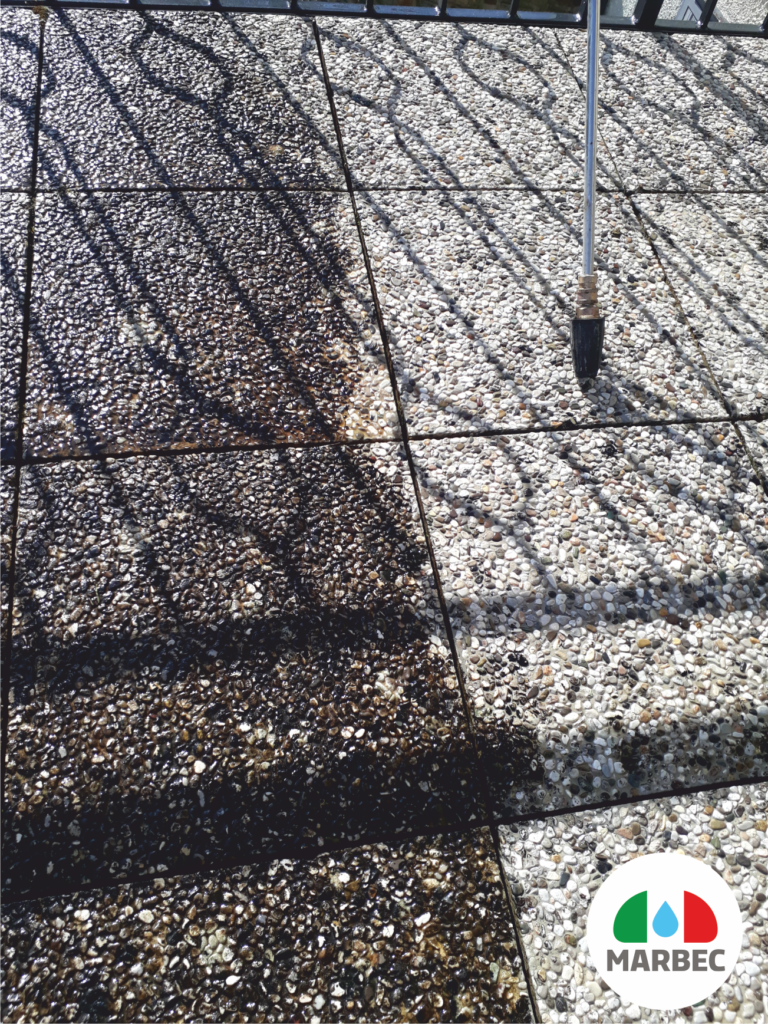
Thanks to this series of operations, the surface was then decontaminated and it was possible to apply TIM, a specific protective product for stone materials (which is also good for internal surfaces) with different qualities.
In fact, TIM avoids the formation of algae, crusts, saline efflorescence and patinas, significantly reducing the absorption of water by the surface and protecting the latter from numerous external factors such as atmospheric or simple foot traffic.
A product therefore that allows not to frustrate the work done by the craftsman, protecting from rising damp and blocking (or at least slowing down) the growth of algae and encrustations.
As we always emphasize, it is essential to use professional products in order to have satisfactory results and not damage the surfaces on which it is necessary to intervene, just as it is to have the right support machinery.
Even more decisive, however, is the human component made up of the professionalism of the craftsman who, with his experience and knowledge, is able to make the best use of the products and machinery available.
This is the case of the artisan Santi Ivano who, by mixing the use of Marbec products and machinery with his skills, has restored this outdoor courtyard in cement agglomeration of cobblestone and natural stones!

Cleaning and restoring indoor varnished wood floors makes it possible to revive matte or glossy varnished parquet flooring that has lost its shine, even colour and original appearance due to everyday wear. When the protective finish is still intact and the floor does not require complete sanding, you can restore parquet without sanding by following a dedicated treatment that removes surface greying, revives the wood and restores the protective finish. This restoration process is suitable for both glossy and matte varnished parquet floors by selecting the treatment that matches the original finish. For this reason, Marbec developed the KIT RESTAURA LEGNO VERNICIATO LUCIDO and the KIT RESTAURA LEGNO VERNICIATO OPACO, two complete systems designed to clean, restore and protect varnished wood floors without sanding or refinishing whenever the floor is still suitable for surface restoration.

An oak parquet floor with an oil-wax impregnation can lose colour, protection, and visual uniformity over time. This often happens because of incorrect maintenance or unsuitable products. However, if the wood is still structurally sound, replacement is not always necessary. With a professional restoration process, the surface can regain balance, beauty, and long-term protection.


