


Our journey continues through the wonderful places in Italy that we do thanks to the column “The best job”. Last time we were in Lazio for the cotto recovery of the residence of a small village.
Obviously, we could not fail to pass through our provincial capital, Pistoia, which houses our latest generation laboratory. For the occasion we are talking about the polishing of a Portoro marble surface that was made by the Renovoart company in a building in this important Tuscan city, of which we are now going to tell you a bit of history.
Pistoia, crossroads of Tuscany
Loved by D’Annunzio who dedicated words to him in ‘Le città del silenzio‘, Pistoia in the 2nd century BC. had already a central role in its support for the Roman troops in the fight against the Ligurians and was a place of conquest for the Byzantines, Franks, Goths and Lombards.
It became a free municipality in 1105, among the historical alliances those with Pisa and Siena are highlighted and its geographical position made it a particularly important commercial crossroads, until the loss of autonomy on 11 April 1306 following the siege of historical enemies Florentines and Lucca. Pistoia then returned to its former glory with the birth of the Grand Duchy of Tuscany and with the arrival of the Lorraine, numerous reforms saw it as the protagonist.
Annexed to the Kingdom of Italy in 1861 it then became a province and seat of the prefecture in 1927 and today it is in the group of cities decorated with military valor for the war of liberation against fascism. Finally, the patron saint is Saint Jacopo (celebrated every 25 July), an apostle invoked to protect the city from the Saracens, honored by liturgical celebrations and the famous race of the “Palio”.
Many monuments and places of interest. From the cathedral of San Zeno to the 30-meter high tower of Catilina, there are really numerous places that tell the centuries-old history of this Tuscan province.
But now let’s talk about… marmetta!
Portoro tiles
But what exactly is the marmetta?
The marmetta is a type of tile made of grit that is used for floor covering. Normally it has a square shape, each side is about 20-25 centimeters and is composed of two layers, a lower one in concrete and an overlying one made of grit or marble chips and colored stones.
Thanks to its characteristics of hardness and resistance, the terrazzo is specifically used for the construction of flooring inside hospitals, shopping centers, service areas, schools and all those areas where foot traffic is particularly frequent.
The portoro, which characterizes the marble in question, instead gives the classic veins and is divided into five types that coincide with the respective main layers, ranging from the so-called step up to the Black and White of Spezia.
Portoro marble has a unique appearance, has a history that dates back to Roman times and is considered a work of art; reasons why it is important to use the right products and the correct procedure for a perfect polish.
How to polish portoro tiles
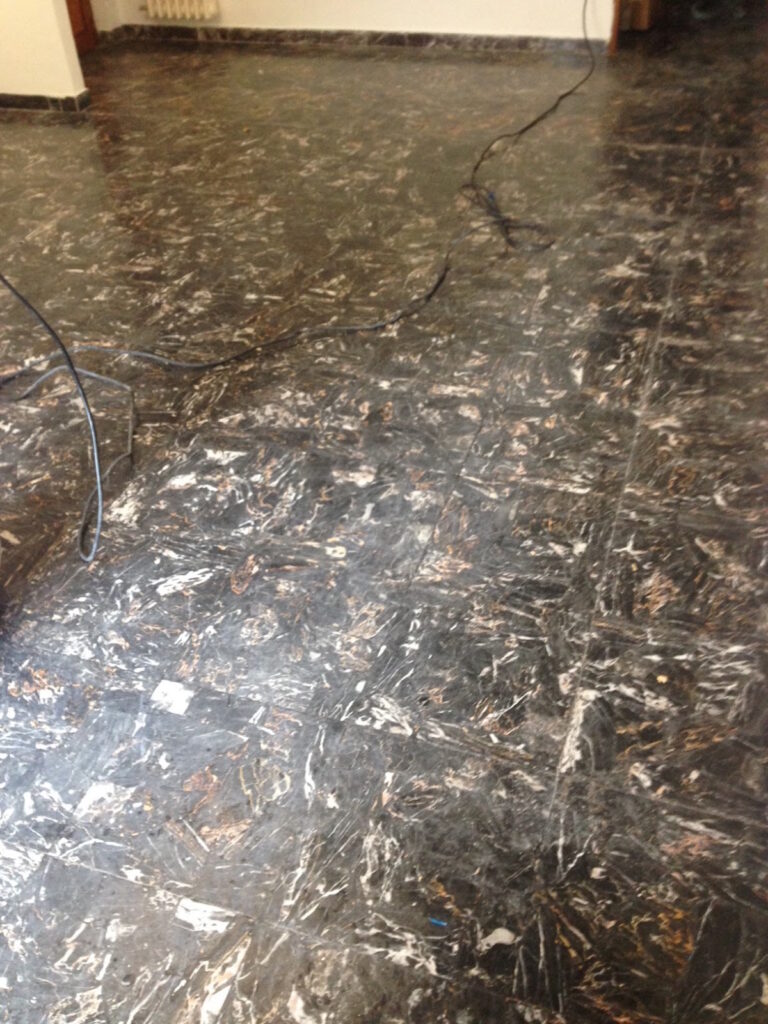
The operation is divided into three phases:
- grinding with single brush
First, the surface layer composed of micro-corrosions and micro-scratches was removed. To do this, a single disc machine equipped with PRELUX DISC was used, a diamond disc that is impregnated directly into the support for a thickness of 3-4 millimeters.
The advice is to scrub with the single disc machine until a white pulp forms, keeping the surface wet while using the PRELUX DISC.
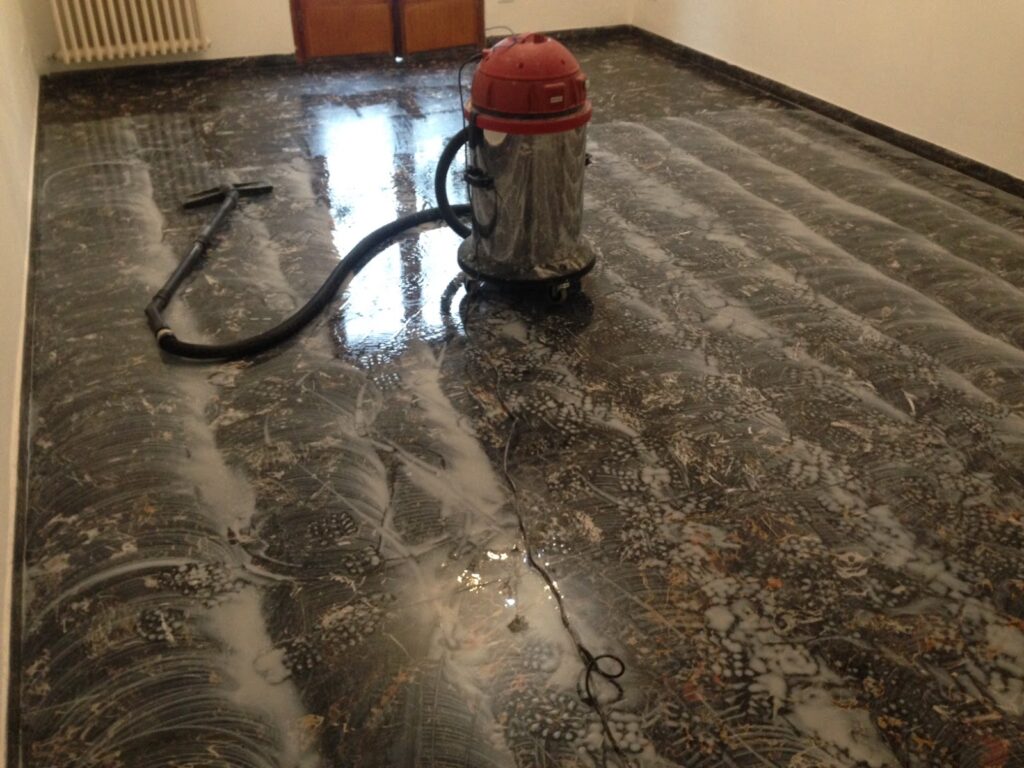
- crystallization with Kw-Star
The second phase consists precisely in the crystallization of the marble which is carried out with the help of KW-STAR, a powder that allows the surface to be restored to shine without changing its natural appearance.
Using the single disc machine, a few grams of KW-STAR powder were poured onto the surface on which the WHITE DISC was subsequently placed. At this point, the water was nebulized around the disc during rubbing.
Once a white mush was formed, the product was worked for a few minutes.
- final wash with Flora
Third and last phase is that of washing the surface with the concentrated neutral detergent FLORA. Spread on the floor with a microfibre cloth, it was left to act for a few minutes and then the surface was rubbed with a sponge.
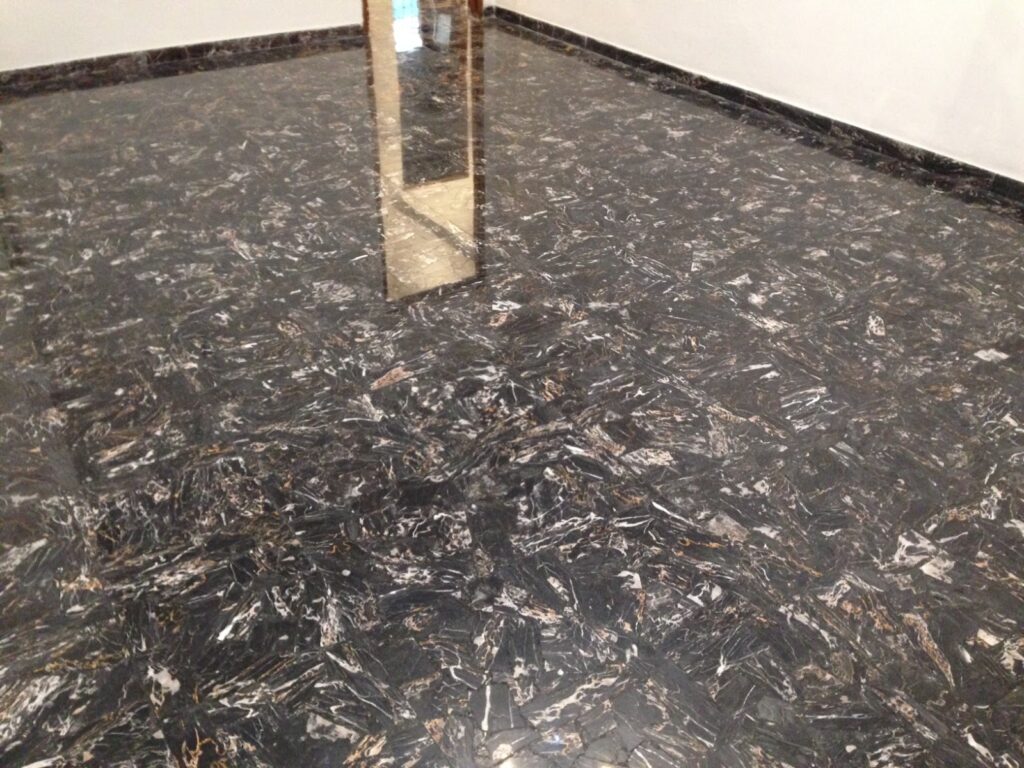
The operation ended with a rinse done with a microfiber cloth and clean water, thus bringing the Portoro marble surface to shine again!

Cleaning and restoring indoor varnished wood floors makes it possible to revive matte or glossy varnished parquet flooring that has lost its shine, even colour and original appearance due to everyday wear. When the protective finish is still intact and the floor does not require complete sanding, you can restore parquet without sanding by following a dedicated treatment that removes surface greying, revives the wood and restores the protective finish. This restoration process is suitable for both glossy and matte varnished parquet floors by selecting the treatment that matches the original finish. For this reason, Marbec developed the KIT RESTAURA LEGNO VERNICIATO LUCIDO and the KIT RESTAURA LEGNO VERNICIATO OPACO, two complete systems designed to clean, restore and protect varnished wood floors without sanding or refinishing whenever the floor is still suitable for surface restoration.

An oak parquet floor with an oil-wax impregnation can lose colour, protection, and visual uniformity over time. This often happens because of incorrect maintenance or unsuitable products. However, if the wood is still structurally sound, replacement is not always necessary. With a professional restoration process, the surface can regain balance, beauty, and long-term protection.


