


If the floor or surface is stained with oil, don’t worry! With our products and the correct application it is possible to remove any residue without leaving a trace.
If you have ever held a bottle of oil in your hand with some terror, it is because you know how boring and difficult it is to eliminate this substance once it has ended up on a surface.
However, removing oil and animal or vegetable fat stains is not an impossible mission.
Between practical tips to follow (but only when the stain is still “fresh”) and specific professional products (for when the oil is soaked), we tell you how to solve this annoying problem!
Oil stains, regardless of the surface they end up on, are a nuisance.
First of all it is essential not to try to clean with soap and water because it only worsens the situation, while it is recommended to use dry absorbent paper.
Once the paper has absorbed most of the oil present, flour or baking soda should be applied and rubbed, finally using a degreaser with water to remove residues.
However, these tips must be integrated with precautions in relation to the floor to be cleaned. For example, if it is necessary to remove oil from marble floors, it is essential to avoid using acid-based products (e.g. vinegar, lemon), while in the case of cotto or ceramic it is sufficient to place absorbent kitchen paper on the stain, rinsing with hot water and soap and, in case of streaks, using specific sprays for the surface.
Finally, if a wooden floor gets dirty with an oil stain, the advice is to use simple baking soda, leaving it to act for a few minutes, and then remove the baking soda dust with a dry cloth or a brush.
But what if the oil stain is old and is now an integral part of the surface?
Here come two specific professional products that solve the problem.
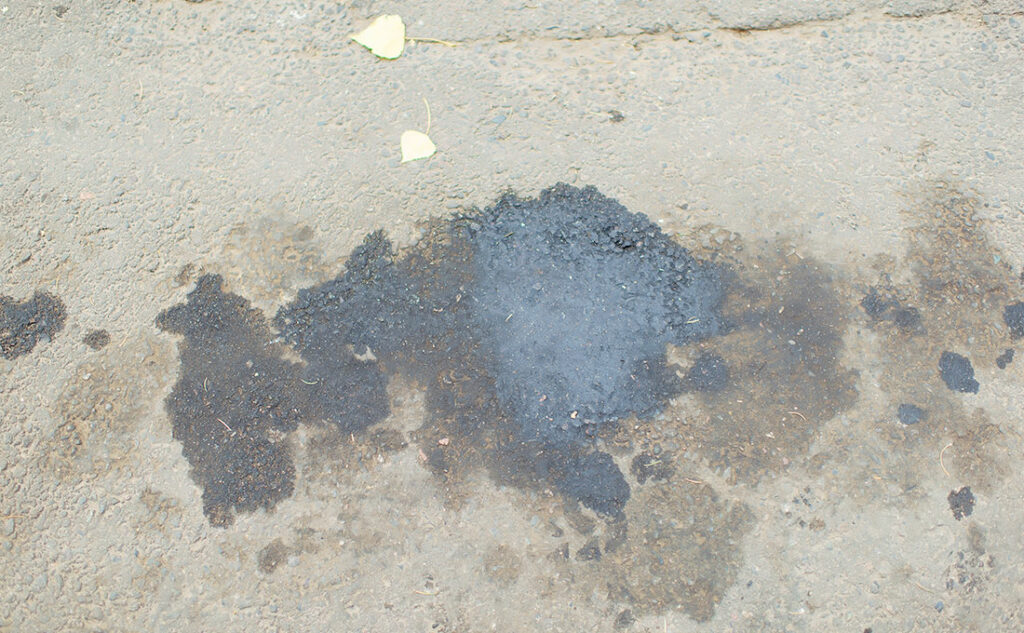
How to remove oil stains from surfaces with professional products
The first product to remove oil stains that have soaked on surfaces is TIXO.
It is a stain remover that is used to remove oil and grease stains of natural origin and, as mentioned, it is ideal for making those spots that have penetrated deeply into the material disappear.
Before use, it must be mixed well and then applied with a palette or spatula, creating a 3-5 mm layer on the stain to be removed. At this point, to slow down the evaporation of the product, you can cover the pack with kitchen film, then let it dry before removing everything with a nylon brush.
If the oil stain has formed on a cotto surface, the advice is to first rinse with DELICACID and then with clean water, while on stone, concrete and grits it is necessary to rinse several times with clean water.
Finally, if the surfaces are treated, it is advisable to apply TIXO on the entire tile concerned, because vice versa there is the risk of creating an uneven surface with the presence of halos.
The other product is SOLVOSILL, a strong solvent stain remover that is used to remove waxes, glues, oils and silicones from stone surfaces, and for which the same instructions for use as TIXO must be followed.
Also in this case the stain remover must be mixed well until a fluid paste is created to be applied (a layer of 3-5 mm) on the stain to be removed. Then, with cling film, you can cover the pack, thus extending the duration of the extraction action, and after a few minutes you can proceed with dry removal.
With DELICACID or UNIPUL (in the case, for example, of polished grit, marble), diluted in water, you can finally proceed with rinsing, repeating the operation on porous or rough surfaces.

Cleaning and restoring indoor varnished wood floors makes it possible to revive matte or glossy varnished parquet flooring that has lost its shine, even colour and original appearance due to everyday wear. When the protective finish is still intact and the floor does not require complete sanding, you can restore parquet without sanding by following a dedicated treatment that removes surface greying, revives the wood and restores the protective finish. This restoration process is suitable for both glossy and matte varnished parquet floors by selecting the treatment that matches the original finish. For this reason, Marbec developed the KIT RESTAURA LEGNO VERNICIATO LUCIDO and the KIT RESTAURA LEGNO VERNICIATO OPACO, two complete systems designed to clean, restore and protect varnished wood floors without sanding or refinishing whenever the floor is still suitable for surface restoration.

An oak parquet floor with an oil-wax impregnation can lose colour, protection, and visual uniformity over time. This often happens because of incorrect maintenance or unsuitable products. However, if the wood is still structurally sound, replacement is not always necessary. With a professional restoration process, the surface can regain balance, beauty, and long-term protection.


