


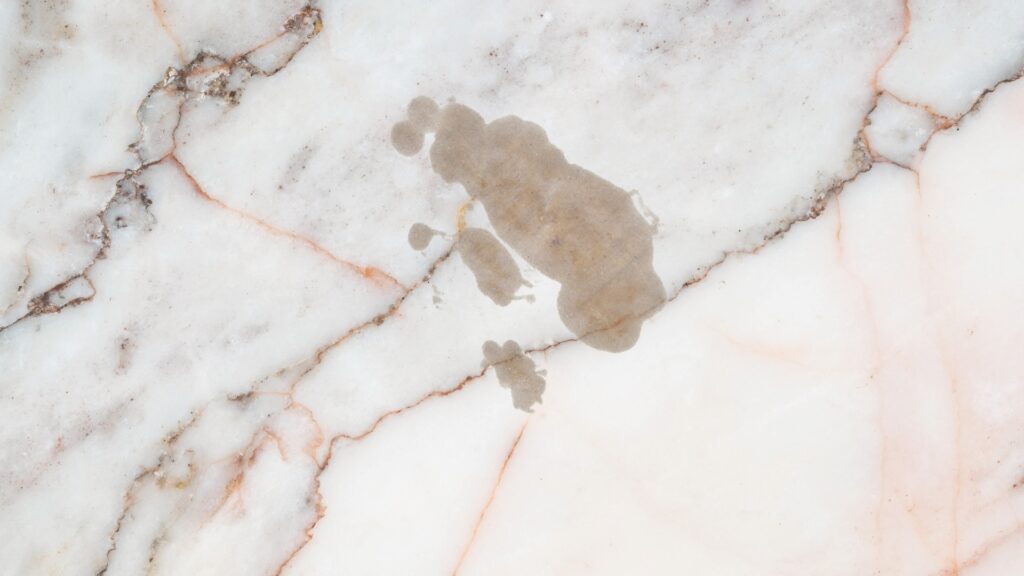
Have you ever spilled oil on the floor?
If the answer is yes, imagine that it was not a very pleasant moment! Removing oil from the floor is not a fun task.
Unfortunately, due to their oily nature, oils and fats can be difficult to remove completely from the floors. Even after intensive cleaning, residues may remain that contribute to the formation of persistent stains. In the article we will see how to remove the oil from the floor.
How to remove oil from porous floor
Oil stains on porous floor, why are they so tremendous? Floors made of absorbent materials, such as natural stone , or untreated cement, tend to stain easily with oily substances such as oil and grease, for several reasons:
- These materials have a porous structure that allows them to absorb liquids, including oils and fats. When these substances are spilled onto the floor, they can penetrate into the pores of the material, making it difficult to completely remove them.
- Oily substances have the ability to adhere firmly to surfaces. When poured on a porous floor, oil and grease can penetrate into the small spaces between the particles of the material and adhere to the surface in a persistent manner.
- In some cases, oily substances may react chemically with floor components, causing color changes or permanent stains.

In essence, a combination of porosity, absorption capacity and adhesion of oily substances makes floors made of absorbent materials particularly susceptible to oil and grease stains. To preserve the appearance and durability of these floors, it is important to take preventive measures and use appropriate cleaning techniques.
Often these materials, as well as inside our homes, are also used for paving outdoor environments. In Italy, we often find outdoor environments with porphyry floor, Luserna stone, quartzite, cement, marble, pietra serena and many other types of stone material. It often happens that outdoor floors are stained with oil or grease, both food and lubricant. So, how to remove oil stains from the outdoor floor?
How to remove oil from the porcelain tiles or ceramic floor
Porcelain tiles is significantly less porous than materials such as marble, natural stone and cement, which makes it more resistant to the absorption of liquids and stains. In fact, porcelain tiles and ceramics are densely compacted and fired at very high temperatures.
Despite this, porcelain tiles and ceramics are not immune from the risk of staining! Even these types of surfaces need attention. In fact, if the oil or grease remains on the floor for a long time, it could penetrate and irremediably stain the floor. In this article, we will also look at how to remove stains from the porcelain tiles floor or ceramic. The solutions, in fact, are the same that we use for natural stone materials.

How to remove oil from the floor: home remedies
Grandma is the first to teach us how to remove oil from the floor:
- one of the oldest remedies of the grandmother is the timely action of the buffer with an absorbent cloth that meanwhile minimizes the formation of the stain;
- this action can then be followed by the distribution of a copious dose of talcum powder or flour or bicarbonate on the stain. These substances will help us absorb the stain from the porous floor. Then, complete the action with the removal of talcum powder, flour or baking soda, with a brush not too hard and possibly with the help of a neutral floor cleaner.
- Another natural remedy is to create a spreadable paste by mixing the baking soda with water. Applying the paste on the oil or grease stain and letting it act for about 15-20 minutes you will get an excellent result. Once the necessary time has elapsed, it is always necessary to remove the spreadable paste by gently rubbing with a cloth or sponge and rinsing with clean water.
Following grandma’s instructions you found out how to clean oil from the floor. But be careful! Before using any remedy, be sure to test it on a small, inconspicuous area of the floor to make sure it doesn’t damage the surface. In addition, it is advisable to act quickly on fresh stains to increase the chances of complete removal. In fact, the more oil penetrates the pores of the floor, the harder it will be to remove it.


What are the most effective products to eliminate oil and fat stains?
There are different types of stains that can undermine our stone surfaces, each with its own characteristics and treatment needs. After trying the home remedies, it is essential to correctly identify the type of stain to be able to remove it permanently with the most suitable professional products.
- Food stains, such as vegetable and animal oils, are typical of the kitchen and can settle on the floor.
- Conversely, stains of lubricating oils are more common on the outside driveways of the house.
Readily recognizing the nature of the stain is the first step to choosing the most effective cleaning method and preserving the integrity of the surface. So let’s see some professional solutions on how to remove oil from the floor. At this point we can not talk about two very efficient Marbec products, thanks to which, the problem of the different oil stains on a cotto, stone, concrete, porphyry, marble or porcelain tiles floor will seem a distant memory.
Vegetable or animal oil stains
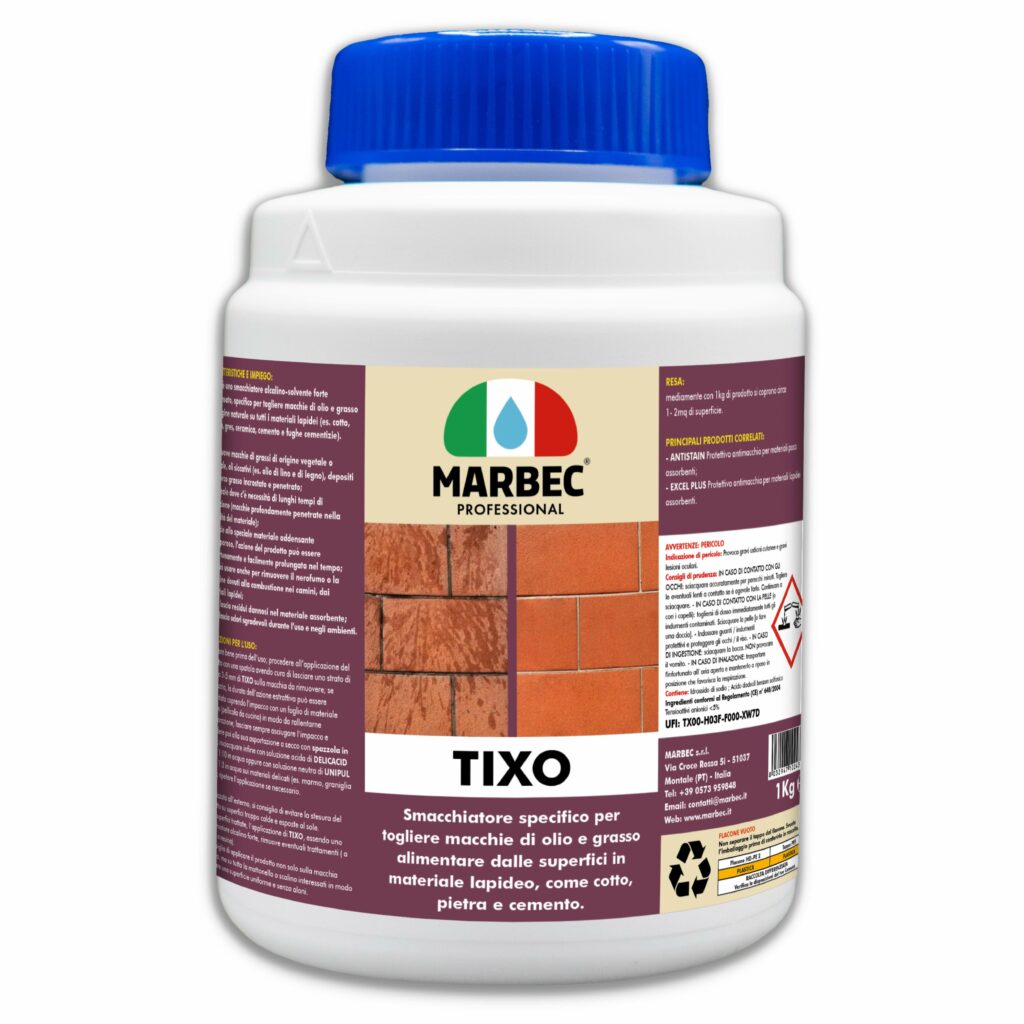
The first product that we propose today is TIXO, thanks to which removing oil stains of animal or vegetable origin will be a breeze. TIXO, in fact, is a specific stain remover to remove oil stains and food fat from stone surfaces, such as cotto, stone and cement, as well as porcelain tiles and ceramic. This strong alkaline-solvent stain remover is ideal where there is a need for long extraction times, that is, where there are stains deeply penetrated in the porosity of the material. Easy and practical to use, TIXO is applied on the stain to be removed with a spatula or a dustpan, does not leave harmful residues in the absorbent material and does not release unpleasant odors during use and in environments.
Lubricating grease or synthetic grease stains
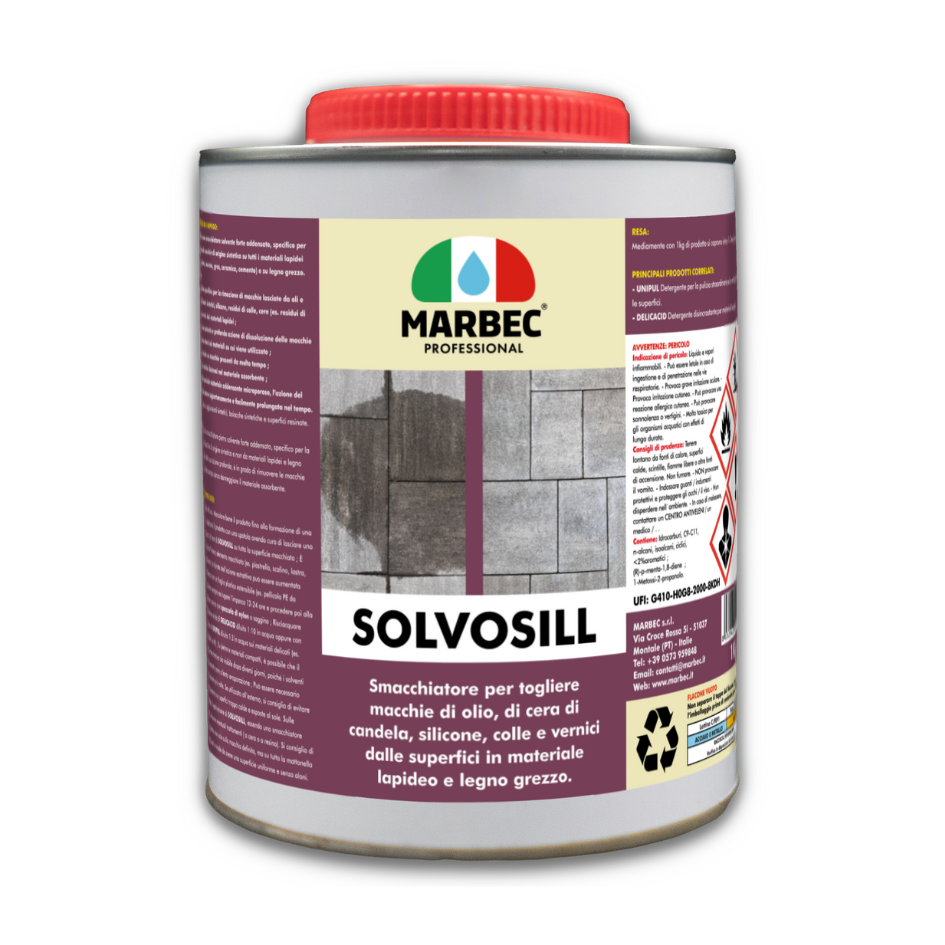
The second product is SOLVOSILL, which permanently removes lubricating oil stains. In fact, SOLVOSILL is a specific stain remover for removing oil stains, candle wax, silicone, glues and paints from stone surfaces such as cotto, stone, marble, porphyry, granite, porcelain tiles, ceramics, cement.
This product is a strong solvent thickened stain remover that has a powerful and deep action of dissolving stains, without leaving halos on the materials. However, it is important to use SOLVOSILL only on stone, porcelain tiles and ceramic materials or on raw wood. While, on other types of materials, especially synthetic ones, it is not recommended to use (synthetic terrazzo, synthetic grouts and resin surfaces).
Are there solutions to protect floors made of absorbent materials from oil and grease stains?
Of course! Let’s see together some of the best practices for cleaning and maintenance of floors made of absorbent materials to prevent such stains:
- First of all, it is advisable to immediately absorb the oil dropped to the ground: in case of oil or grease spills, it is important to act quickly by absorbing the liquid with an absorbent cloth or paper to prevent it from spreading and entering the floor. In fact, as we have already seen, stone materials are often very porous and therefore favor the penetration of oil.
- A very effective way of protecting the floors would be to prevent the formation of the stain altogether. In this case there are various professional products, such as protective and oil-repellent, that can help us. Let’s see some protective formulated by Marbec technicians:

The first product really useful in the protection of floors from oil and grease is EXCEL PLUS, an oil-repellent protective for the stain-resistant treatment of absorbent stone materials, such as cotto, absorbent stone, plasters, cement and terrazzo placed inside and outside. The strength of this product is its special water-based formulation, which makes it odorless, not dangerous and easy to use, even by novice people in floor maintenance. EXCEL PLUS works by eliminating or drastically reducing the absorption capacity of liquid and fat substances. Moreover, it does not form superficial films, is invisible and does not alter the appearance of the material and the color tone over time. This product is suitable for all absorbent stone materials, both indoors and outdoors. When used outdoors it gives a strong anti-stain and self-cleaning protection with rains with a high chemical inertia and resistance to atmospheric agents and trampling.

GUARD is also a stain-resistant oil-repellent protection, but it is more suitable for compact and poorly absorbent stone materials, such as internal and external marble, granite, polished terrazzo. GUARD forms an oleophobic chemical barrier, but does not form films or surface patinas, is invisible and does not alter the appearance of the material and the color tone over time. Just like EXCEL PLUS, this product is also water based and for this reason it is odorless and not dangerous or toxic for people and the environment.
Marbec also has two other stone protectors in its catalogue, which are water-repellent and stain-resistant. The first is TIM, a water-based protective water-repellent stain-repellent, specific for absorbent stone materials, such as cotto, natural absorbent stone, cement, mineral plaster. Unlike other treatments, TIM is easy to apply and does not release unpleasant odors. The other protective water repellent is ACTIV3, a protective for water-repellent and stain-resistant treatment for absorbent stone materials, such as cotto, natural stone absorbent, cement. This protective eliminates or drastically reduces the absorption of water and liquids, fatty substances and oils in the material, but at the same time it is breathable, thus retaining the original permeability of water vapor surfaces. In addition, ACTIV3 avoids and counteracts rising humidity (and consequently the formation of saline efflorescence, crusts, patinas, algae, etc.). In addition to this, ACTIV3 does not create films or patinas on the surface and has a high resistance to weathering and trampling.

-

SOLVOSILL®
Stain remover for removing oil stains, candle wax, silicone, glues and paints from stone and raw wood surfaces.
+ Varianti33.83€
-
EXCEL PLUS
Professional protective for the stain-resistant treatment of absorbent stone materials. It does not create film, is breathable and does not alter the appearance of the material.
+ Varianti27.69€


Easter is one of those moments of the year when the home fills again with family and friends. The Easter lunch often becomes the perfect occasion to gather around the table and spend time together. Before guests arrive, it is therefore natural to want to tidy up the house and take care of the details that make rooms feel welcoming. You do not need a full deep clean. In most cases, a few targeted cleaning tasks are enough to prepare the most used areas of the home, such as the kitchen, dining room, living room and guest bathroom. In this guide you will discover how to organize your home cleaning before Easter, with practical tips to make your spaces tidy, comfortable and ready to welcome family and guests.

Bathroom cleaning requires the right products and a clear method. In this part of the home, limescale, soap residues, mold, humidity stains and mineral deposits tend to build up quickly. These problems are especially common on showers, faucets, glass panels and tile grout. For this reason, effective bathroom cleaning relies on targeted cleaning products designed for specific types of dirt. Combining descaling cleaners, sanitizing solutions and practical cleaning tools makes it easier to remove deposits and maintain surfaces over time. With Marbec solutions, it is possible to manage both intensive bathroom cleaning and regular surface maintenance in a simple and organized way. As a result, showers, glass panels and sanitary fixtures stay cleaner and easier to maintain.


