


Do you have an external teak floor? Here are some tips to prepare it for a new summer!
Due to its characteristics of being resistant, durable and not subjected to rottenness, teak is a perfect material for exteriors, which gives elegance to thanks to its natural beauty. However, even this material needs, subjected to climate change and bad weather, to be renewed.
However, thanks to the professionalism of the LineAperta Social Cooperative, we will see how, in a few steps, it is possible to easily renovate the external teak floor. So let’s go and see what it is and what the characteristics of teak are, before discovering together the steps to renovate an outdoor teak floor.
Teak: what it is and what its characteristics are

Teak (or teck) is a species belonging to the genus of Tectona trees, typical of south-east Asia, which the modern phylogenetic classification places in the family of Laminaceous plants. The color of its wood ranges from pale yellow to bronze and in some cases tends to red. Inside there is a natural oily resin that has the quality of making this material extremely resistant.
Thanks to its characteristics, teak finds space on an industrial level in the field of carpentry, construction, building, in the creation of furniture and interiors, as well as in the nautical sector.
Beauty, strength, durability, ductility and resistance to rottenness are some of the main characteristics of teak, which arrived in our continent in the early 1900s and was immediately used in the naval industry. Currently it is increasingly used, as well as in the production of doors and windows, in the construction of garden furniture and in the construction of floors.
So let’s see how to renovate an external teak floor.
Renovating an external teak floor: here are the steps
The intervention is carried out by the LineAperta Social Cooperative, a reality that carries out a Quality Policy characterized by attention to the customer, adoption of a process approach, the principle of continuous improvement, the decision-making process based on facts and a stakeholder engagement philosophy.
The artisans called to intervene on the external teak floor were Daniele Taschini and Said Nassif, who made their professionalism available for this work, created with the use of Marbec products.
Phase 1 – Application of Smacchio Legno

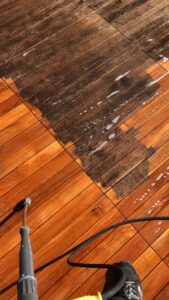
First, the experts applied SMACCHIO LEGNO, stain remover for aged and tannin-stained wood on the teak exterior floor. It is a specific detergent for removing the gray patina of wood aging, it renews the natural appearance of the wood and prepares it for the application of a new treatment. It removes stains and tannin halos.
This application is followed by an intervention with a pressure washer for washing the SMACCHIO LEGNO.
Phase 2 – Mesh sanding
The protagonist of the second phase of the renovation of the external teak floor is sanding, that is the smoothing of the surface with a sandpaper. In this case, the experts carried out an initial sanding with an 80 gr mesh to remove the “skin” created and a subsequent sanding, to finish this phase, with a 120 gr mesh.
Phase 3 – Application of Oil 41, Diluoil, Oiltoner Noce
In the third phase Daniele and Said applied OLIO 41, an oily-waxy impregnating agent for external wooden floors, with DILUOIL, thinner for Marbec oil-waxy impregnating agents such as TIROIL, TUSCANIA OIL, OLIO41, FLUOIL, OIL TECNO, OIL WET, and with OILTONER NOCE, product in an oil-soluble dispersion in an aliphatic solvent of inorganic pigment to colour the oil-soluble products.
For this application the two experts used 1000 grams of OIL 41, 400 grams of DILUOIL and 14 grams of OILTONER NOCE.
Phase 4 – Polishing and application of Fluoil, Oiltoner Noce

After 12 hours Daniele and Said polished the external teak floor with the RED DISC, suitable for cleaning floors with the spray method and excellent for removing surface black traces without affecting the protective layers of the surface.
The RED DISC, among other things, is ideal for performing extraordinary cleaning and for applying impregnating products on wood, cotto, stones.
This is followed by the application of 100 grams of FLUOIL, an oil-waxy anti-decay impregnating agent for external woods, and 7 grams of OILTONER NOCE.
And finally? After 24 hours a nice final polishing with our RED DISC.

A clean and sanitized home depends not only on how often you clean, but also on the methods and products you choose. When selecting professional household cleaning products, it is important to distinguish between routine cleaning, deep cleaning and targeted cleaning tasks. Using the right solutions helps remove dirt, dust, residues and surface films, supports everyday hygiene, and keeps surfaces looking their best for longer. A thorough home clean is also the perfect opportunity to tackle those household chores that are often put off.

After a renovation, parquet flooring can look dull, dirty, and covered with construction dust and debris. Before considering a complete sanding, it is worth evaluating a proper deep maintenance treatment. In many cases, the beauty of the wood can be restored while preserving the natural character and authentic lived-in appearance that make every parquet floor unique.


