


Rust stains on stone materials are a common problem, especially on outdoor floors. These unpleasant yellowish halos can ruin the aesthetics of stone surfaces, making them difficult to eliminate. The care of our plants can sometimes lead to nasty surprises. In fact, the use of fertilizers and fertilizers for the lawn can encourage the formation of rust stains on stone materials. These products contain ferrous sulfate, which can cause the formation of rust stains. These stains not only disfigure the beauty of the material, but are also difficult to remove. In this article, we will explore how to remove rust from surfaces and provide useful tips to prevent and treat this common problem.

Why do rust stains appear on our floors?
What causes the appearance of these unpleasant stains on our floors? There are several causes for the formation of rust stains. Let’s see some of them:
- Fertilizers – Fertilizers, especially those intended for lawn greening, often contain ferrous sulfate (iron sulfate). This compound is used to feed plants and correct iron deficiencies in the soil. However, if these fertilizers end up on outdoor floors, such as stone or tiles, the iron contained in ferrous sulfate can react with the moisture present in the environment. This causes the formation of rust spots, which appear as unsightly yellowish spots difficult to eliminate.
- Water – Iron-rich water can contribute to the formation of rust on floors. When water with a high iron content is used for irrigation, iron residues can settle on nearby floor surfaces. Over time, exposure to oxygen and moisture causes iron to oxidize, creating rust stains. To prevent this, it is important to manage irrigation systems well, making sure that water does not accumulate on stone or tile surfaces and, if necessary, installing filters that reduce the iron content in the water.
- Rust on marble – Rust stains on marble can be caused by different sources. In addition to fertilizers and water rich in iron, marble itself can contain traces of ferrous minerals that, over time and with exposure to moisture, can oxidize and form rust spots. In addition, the use of metal tools or metal furniture on marble surfaces can leave ferrous deposits that then oxidize. Prevention consists in avoiding prolonged contact with metal objects and protecting marble from moisture. In the article we will also see how to remove rust from marble.
Effective methods to remove rust
To remove the annoying rust stains from the floor, it is essential to dissolve rust. If the stains are small and not too large, we can try some natural remedies:
- Lemon juice: Soak the stains with lemon juice, leave for an hour, then wash the floor with water and mild soap. Be careful not to use lemon on stone materials such as marble, because its acidity could corrode the surface.
- Salt paste: Mix some salt with a little water until you get a thick and pasty solution. We apply the cream on the stains, let it act for 24 hours, then we wash with cold water.
- Baking Soda: We sprinkle the bicarbonate stain and rub it vigorously.
These simple remedies can be effective to rid our floors of small and superficial rust stains, but they will not be enough in the case of large and highly stained areas.
Rimozione della ruggine con TOGLIRUGGINE LIQUIDO
Now we come to a professional product, which is the perfect ally against rust stains and helps us even in the case of more delicate materials, which risk being damaged if we use too aggressive substances. Here’s how to remove rust from marble and other stone surfaces.
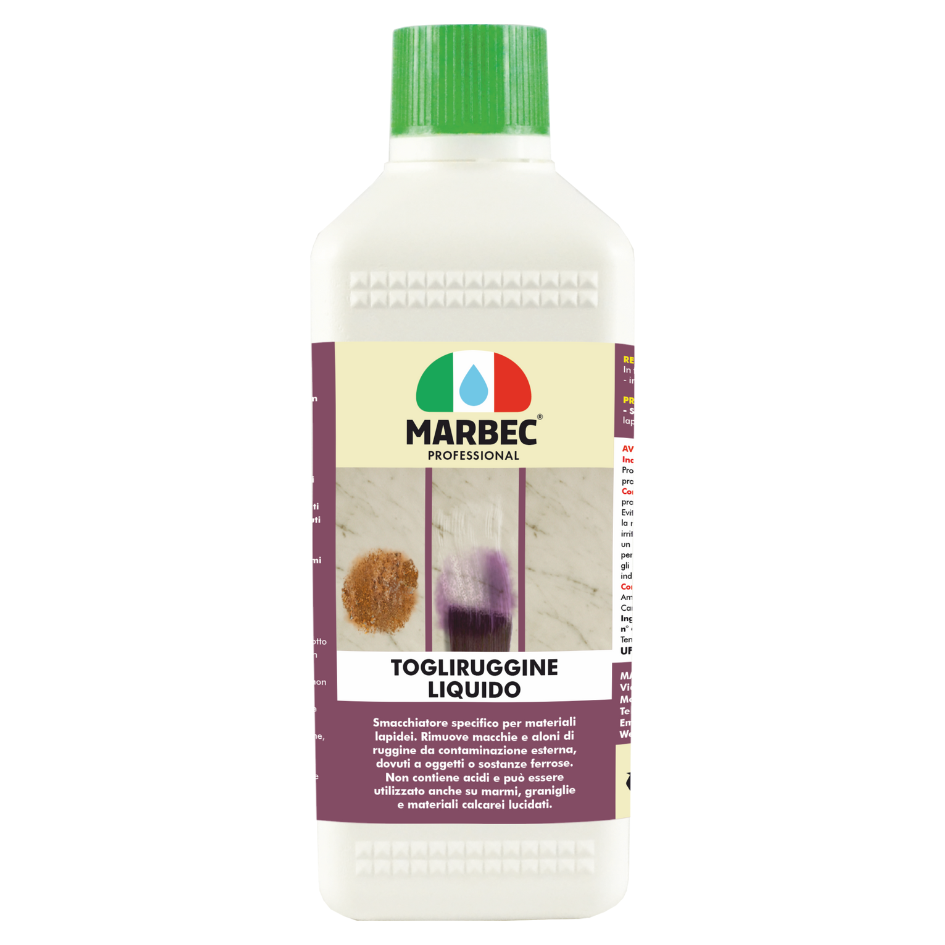
If rust stains are extended or have been present for a long time, you should use a specific product such as TOGLIRUGGINE LIQUIDO. This ready-to-use stain remover removes metal oxide stains and protects all stone surfaces from rust.
TOGLIRUGGINE LIQUIDO acts quickly and, not being an acid product, is safe even on delicate materials such as polished marble and travertine, polished grits and slate.
TOGLIRUGGINE LIQUIDO should be applied to the surface with a brush, taking care to leave an abundant layer of product on the stained area. The product should be left to act for 10-15 minutes until it becomes a dark purple color. At this point you can rub the surface with a slightly abrasive sponge or with a BLUE BUFFER.
It is important not to let the product dry on the surface. In fact, once the reaction has occurred, it is recommended to remove the product within 10-15 minutes, rinsing with a slightly alkaline aqueous solution (e.g. SGRISER diluted to 10% in water).

Uso di SGRISER per trattamenti prima e dopo la rimozione della ruggine

The SGRISER product is a strong cleaning agent for stone materials, which removes old oil and/or wax treatments from stone materials such as cotto, marble stone, cement and grits. Deep cleans and degreases soiled surfaces of oils, greases and organic scale. In addition to this, it is also used to carry out neutralizing alkaline rinses, after the use of other substances. Given its characteristics, SGRISER is very useful for removing rust stains. In fact, it is used to prepare the surface before removing rust and also to thoroughly clean and neutralize after removing rust.
De-waxing treatment before rust removal
This product is very useful to remove old oil or wax treatments that could retain rust residues, preventing the removal with the simple use of TOGLIRUGGINE LIQUIDO. When you want to use SGRISER for its dewaxing action you need to spread the product on the surface and let it act for 10-20 minutes. Once the necessary time has passed, rub the surface with buffers or abrasive discs made of plastic fibers, or with nylon brushes.
Neutralizing wash
The alkaline rinse is recommended especially for the most porous surfaces, because there is the risk that TOGLIRUGGINE LIQUIDO penetrated deeper leaves residues of purple color. Instead, the washing with SGRISER diluted in water neutralizes the rust remover, leaving the surface completely clean. In this case, it is recommended to dilute SGRISER to 10% in water and wipe the surface with a soft cloth or sponge.
BLUE BUFFER: effective in removing rust stains

BLUE BUFFER, thanks to its slight abrasion, is particularly effective in removing surface rust stains, especially on hard floors such as porcelain tiles and ceramics. This tool is ideal for achieving a deep and targeted cleaning, without damaging delicate surfaces. As we have already seen, together with TOGLIRUGGINE LIQUIDO is recommended the use of BLUE BUFFER, which with its slightly abrasive action helps to penetrate the porosity of the material and to remove stains more effectively. Using the BLUE BUFFER in combination with specific products for removing rust, you can get perfectly clean and stain-free floors. This method is especially useful for those looking for effective solutions on how to remove rust from tiles, ensuring a deep and lasting cleaning.

Watch our tutorial video of the application
Our tips for preventing rust stains
As the saying goes, prevention is better than cure!
So we show you simple steps to try to better protect the outdoor floors so as not to come across the appearance of rusty stains.
- Before starting gardening operations in the presence of stone surfaces such as floors, terraces, paths, we protect the ends of the border with nylon or old sheets and paper tape. Isolating the surface will prevent contact.
- To spread the fertilizer, in the “border” areas between lawn and floors, we use precision brushes.
- During the application of the fertilizer and in the first days after, we always take care not to step on the product and then walk on the stone floors, we always use special shoes.
-

TOGLIRUGGINE LIQUIDO
Specific stain remover for stone materials. Removes rust stains and halos from external contamination, due to ferrous objects or substances. It does not contain acids and can also be used on marble, grits and polished limestone materials.
+ Varianti14.79€
-
BLUE BUFFER PAD | Light Abrasion
Polyester fibre pad to use for the removal of surface layers of wax and delay the washing of resilient floors treated with metallic waxes. Removes scratches and signs.
5.32€


Easter is one of those moments of the year when the home fills again with family and friends. The Easter lunch often becomes the perfect occasion to gather around the table and spend time together. Before guests arrive, it is therefore natural to want to tidy up the house and take care of the details that make rooms feel welcoming. You do not need a full deep clean. In most cases, a few targeted cleaning tasks are enough to prepare the most used areas of the home, such as the kitchen, dining room, living room and guest bathroom. In this guide you will discover how to organize your home cleaning before Easter, with practical tips to make your spaces tidy, comfortable and ready to welcome family and guests.

Bathroom cleaning requires the right products and a clear method. In this part of the home, limescale, soap residues, mold, humidity stains and mineral deposits tend to build up quickly. These problems are especially common on showers, faucets, glass panels and tile grout. For this reason, effective bathroom cleaning relies on targeted cleaning products designed for specific types of dirt. Combining descaling cleaners, sanitizing solutions and practical cleaning tools makes it easier to remove deposits and maintain surfaces over time. With Marbec solutions, it is possible to manage both intensive bathroom cleaning and regular surface maintenance in a simple and organized way. As a result, showers, glass panels and sanitary fixtures stay cleaner and easier to maintain.


